In today’s digital era, the rapid spread of information through social media and the internet has created an environment where misinformation can circulate more widely and quickly than ever before. This vast connectivity amplifies both accurate news and falsehoods, making it increasingly challenging to discern facts from fake news. Things such as AI and conspiracy theories can quickly amplify misinformation, spreading it across platforms at an unprecedented speed. AI tools can generate convincing, but false content, while conspiracy theories often tap into emotions and fears, making them especially viral. Together, they create a potent mix that challenges our ability to stay informed and discerning in the digital landscape.
With the recent journey of Artemis II, so much content and news has spread about this historic feat. However, this widespread attention also leads to the rapid circulation of misinformation. As excitement grows, inaccurate details, rumors, and conspiracy theories can easily mix with factual updates, making it harder for people to separate truth from falsehood amid the flood of information.
While scrolling on social media, I have seen many videos and posts claiming the entire Artemis II mission was fake.
Here are just a few of them that I saw:
When encountering content like this, the lengths some people go to convince their audience that the mission was fake can be surprisingly persuasive, swaying many to their side. However, the knowledge I’ve gained from this module has made me much more skeptical, instantly raising red flags about trusting such conspiracy theories. To investigate further, I applied the lateral reading method of cross-checking information by consulting multiple sources to understand why some claim the Artemis II mission wasn’t real. A quick Google search revealed numerous articles and videos thoroughly debunking these false claims.
I came across an article titled, Is That Moon Photo Real? How to Spot Artemis II AI Slop by the San Francisco Standard, which explains how to use reverse image search to trace the original source of a photo. From there, you can assess whether the source is reliable or potentially part of a hoax. The article also highlights that fact-checking sites are excellent at quickly debunking misinformation. For example, if you visit Snopes and search “Artemis,” you’ll find a comprehensive list of all the false claims related to the mission.
This video, NASA’s Artemis II: conspiracy theories take off about ‘staged’ green screen by France 24 English also discusses the conspiracies and does well in debunking them in a short four minute video. It mentions points such as there being a TV traffic glitch during a live stream, as well as a photo going around of the crew floating in front of a green-screen that has been confirmed as AI-generated.
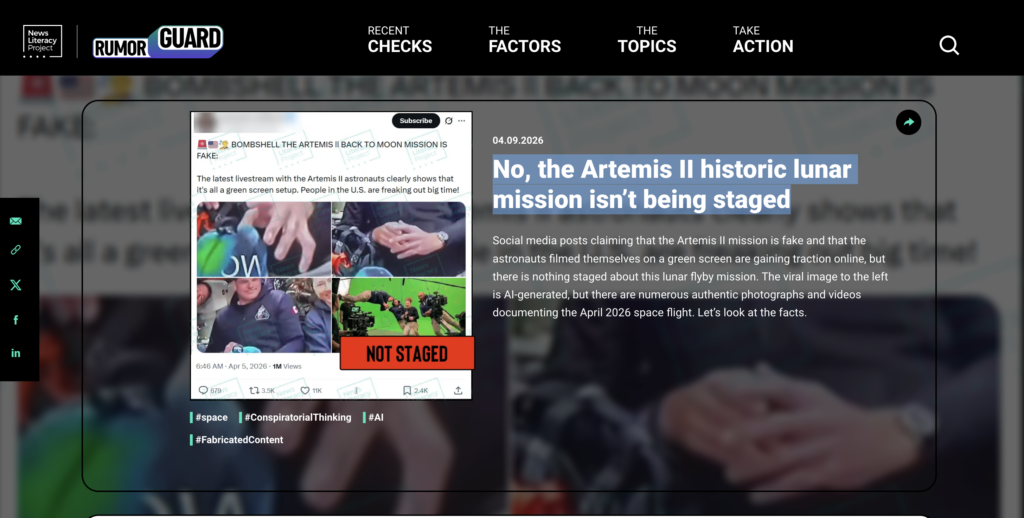
Something that I took away from last week’s module was using RumorGuard for fact-checking. I was pleasantly surprised to see that they had recently posted a segmented about Artemis II titled, “No, the Artemis II historic lunar mission isn’t being staged.” This post confirms what France 24 was reporting about images being AI, and the overwhelming evidence of the mission being real.
In conclusion, lateral reading was my key method for debunking the false claims I encountered. Although this topic wasn’t especially complex, thanks to the abundance of articles and videos about Artemis II, it demonstrated how one credible article can open the door to a wealth of reliable information. For instance, the San Francisco Standard article guided me to Snopes, which offers a detailed list of AI-generated images related to the mission.
My approach was straightforward: conduct a simple Google search and carefully verify that the sources I consulted were trustworthy and valuable