With social media being such a big network of interconnected users who share so much online, the spread of misinformation has become a significant obstacle for these online platforms. Misleading or false information can quickly travel, causing a surge of misinformation for other people to see and propagate. This issue can warp the public’s understanding and opinions, sometimes even encouraging negative behaviors. Without critical evaluation, misinformation can thrive in an environment where people are not fact-checking, making it difficult to distinguish fact from fiction. Platforms need to ensure they provide the means to educate and promote fact-checking for all users, as well as the ability to constantly double check and review what their users are posting or interacting with.
For this project, we will be observing two social media platforms, TikTok and X, and how they handle misinformation.
TikTok
Like most platforms, TikTok has a service agreement when you download the app. Within their Terms of Service, TikTok prohibits misinformation that can mislead users, especially about popular and ongoing topics, such as climate change and political issues. TikTok’s Advertising Policies must align with well-established scientific consensus to avoid spreading false information. Their principle states, “While we encourage open dialogue, we are committed to maintaining a safe and trustworthy environment by taking action against misinformation, such as false, misleading, or unsubstantiated content, and manipulated content which misleads viewers into perceiving it as published by reputable and qualified sources such as news outlets or government agencies, that could harm individuals or society regardless of intent.
TikTok and the War on Misinformation discusses this topic of misinformation on the popular app and the issues they may come across. A report done in 2022 found that about one in every five videos on TikTok contain some sort of false or misleading information. The article mentions that TikTok, similar to most media platforms, can be vulnerable to misinformation that captures attention through sensational headlines, exaggerated language, and emotional appeals. These strategies play on users’ curiosity by presenting overstated or deceptive content that claims to reveal shocking news, uncover scandals, or provide miraculous answers. Their purpose is to create a feeling of urgency, encouraging users to click and interact impulsively without careful consideration. When videos are uploaded to TikTok, they first go through an automated moderation system that checks for breaches of the platform’s community guidelines, including issues like nudity or threats to child safety. If flagged, the content is typically examined by one of TikTok’s tens of thousands of human moderators who assess it with greater context and understanding. This helps alleviate some of the harmful content before it can spread to other people.
This YouTube video by NowThis Impact touches on instances where misinformation got out of hand, like during the Ukraine invasion. The commentator talks about how TikTok was involved, and emphasizes that while TikTok does have policies, it is up to the individual user to educate themselves on spotting misinformation.
X
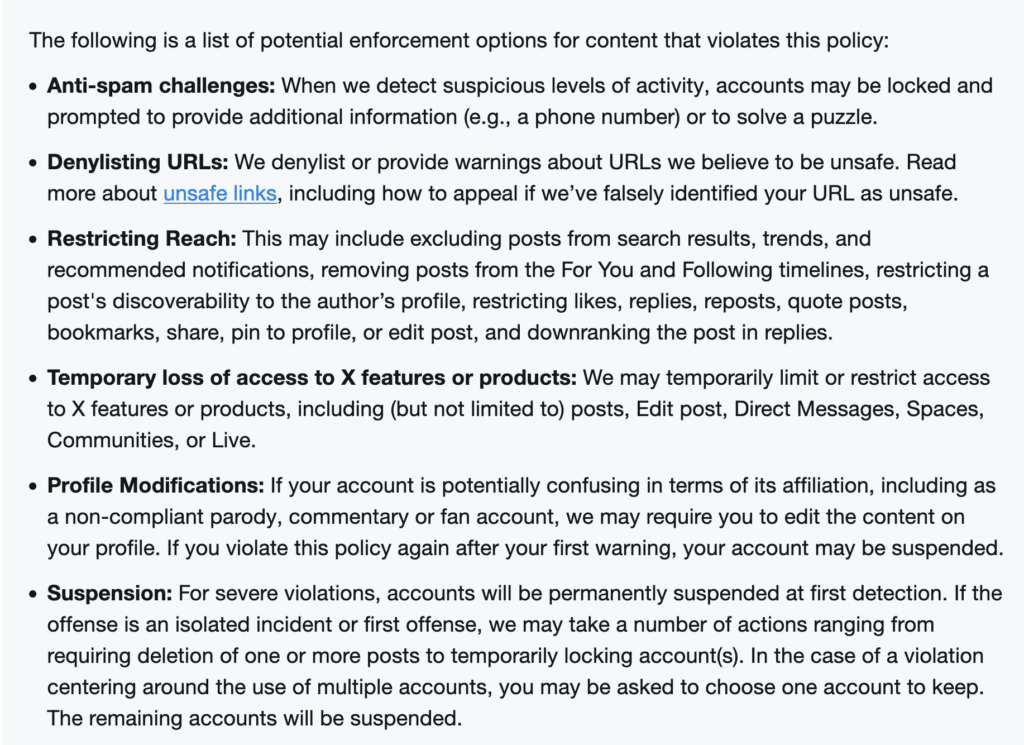
Twitter, now rebranded as X, has similar ways to combat misinformation. Their Help Center has an Authenticity page that clearly establishes their rules and regulations of what is and isn’t allowed on their platform. They have strict rules on inauthentic accounts, content, and behaviors. This image describes what the consequences are for certain violations of their policies:
Community Notes on X could be key to curbing misinformation examines how a large amount of news originates from X. In 2021, Twitter launched a pilot program called Birdwatch, aimed at addressing misinformation directly on the platform. It invited users to submit corrections or provide additional context to tweets that were false or misleading. The program was later renamed Community Notes, and following Elon Musk’s acquisition of the platform in 2022, it was expanded significantly. This article follows an assistant professor, So Gao, and his look into Community Notes. The project ended up being successful, much to Gao and his team’s surprise. The data showed that X users were more willing to retract their tweets in response to notes.
Here is a video further emphasizing what Community Notes is and how it helps curb misinformation on X:
Conclusion:
TikTok and X both take active measures to prevent misinformation on their platforms, but do so through somewhat different approaches aligned with their community guidelines and features. While TikTok has been strengthening their policies, X has been using their Community Notes to encourage users to contribute to their fact-checking system. These platforms are continuously evolving, but still have a ways to go.
From personal experience, TikTok oftentimes labels content that might need fact-checking with a description on the “why.” However, there is not a large community or environment of fact-checking, which leads to people fueling the flames on videos that get any sort of traction. I think TikTok could flourish better with a feature similar to that of X’s Community Notes, where users could engage in adding context to misinformation. I also believe they should crack down on AI-generated content, as it is already immensely spreading all over their platform.
X could improve by following through better with their penalties for anyone who breaks the rules and regulations. There are many bots and fake accounts that purposefully spread false information, amplifying harmful narratives. Strengthening detection methods and imposing stricter consequences would help deter coordinated disinformation campaigns and protect the integrity of conversations on the platform.